Setting Boundaries and Showing Up - June 2026
Summary
Have you ever asked someone “what do you need?” and they don’t have an answer? Or maybe they asked you for the kind of support you don’t have the capacity to offer. This session focused on how we can make tangible offers of support based on our strengths in balance with setting and maintaining boundaries so we don’t overextend ourselves.
This presentation will draw heavily on the Living Experience of the facilitator, Wendy Hayes, as well as two books they love:
“There Is No Good Card for This: What To Say And Do When Life Is Scary, Awful, And Unfair To People You Love” by Kelsey Crowe, Emily McDowell
“Say the Thing: Boundary-Setting Scripts & Phrases to Communicate Directly & Speak Up with Kindness” by Kami Orange
Soundbites & Takeaways We Loved!
Start with practicing kindness and compassion towards ourselves; this can help us to extend our kindness and compassion more to others.
When people come to us with their challenges or struggles, it can help by starting with asking if they want to vent or it they are looking for problem-solving ideas to understand what they need from us. This can be freeing for us as caregivers and supportive people who often feel like we have to be "fixers".
When people are resistant to our problem-solving ideas, this can be a cue to slow down and refocus on listening.
Think about advice as salt: some people will like a little, some people will like a lot, and some people won't want any at all.
When giving advice, it's important to balance intent vs. impact. We may be intending to be helpful, yet advice can often feel like judgment and trigger shame.
A helpful phrase when being asked for advice "I can tell you what I might do, but I think you're the best person to decide for you and I'll support you with whatever you choose."
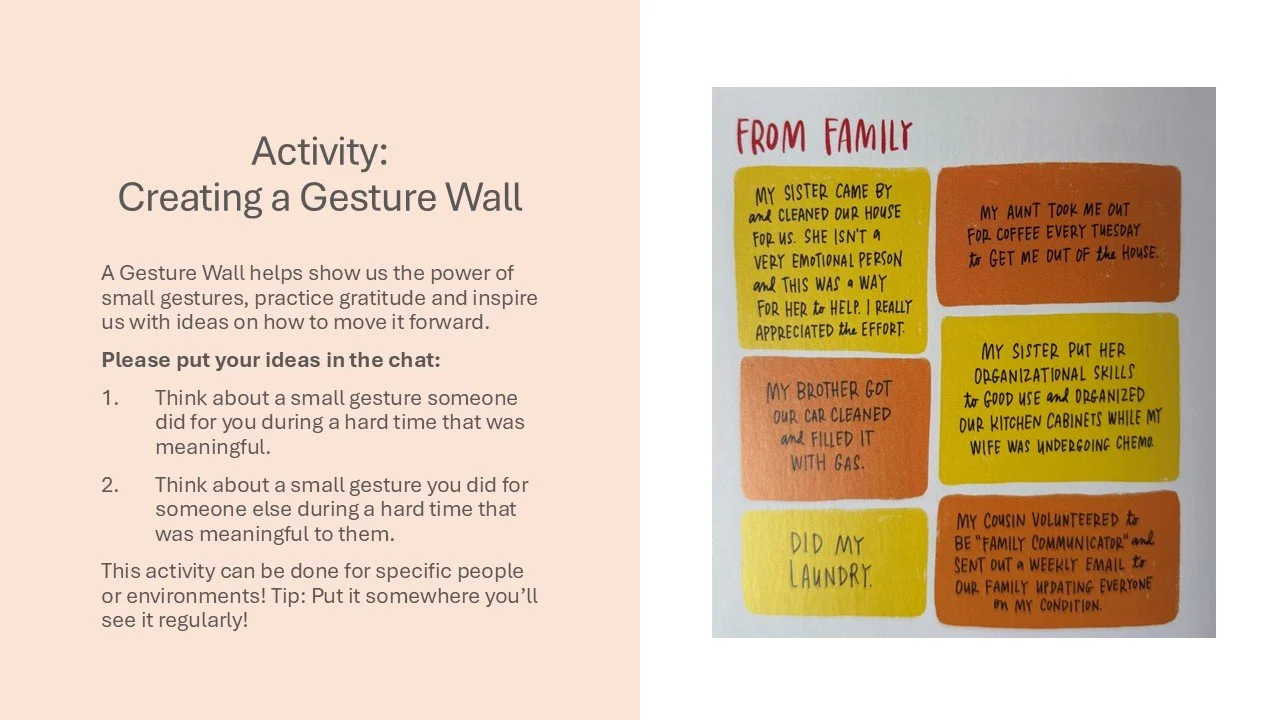
Remember that small gestures can make a big difference. Create a Gesture Wall (see Actionable Ideas and Activities below).
We are going to be more motivated to do things we like doing and things that make us feel competent, make offers of support that draw on our strengths and joys.
Lived Experts often learn they are a burden to the system, to their social workers, to foster caregivers and/or group care staff. Using language like "I want to…[insert offer here]" rather than asking "Do you need/want me to…[insert offer here]" can help Lived Expert accept support because we are enthusiastically showing up.
Acknowledging that we don’t have control over others, situations or outcomes, boundaries help us focus on moving towards mastery of the self by setting self-imposed limits or rules that help us say yes and no based on our current resources. Read more about boundaries here.
When setting point-in-time boundaries (like needing to take a break from an interaction that is becoming intense), we do our best to plan and/or have a moment of reconnection. This may contribute to reducing abandonment triggers over time.
Try to balance showing up/boundary settings to be SIMILAR while in crisis (or excitement) and “just because”. Show them: you don’t have to be in crisis for me to show up, I will show up any time. This can help build trust through consistency and reduce burnout for ourselves.
Facilitator Boundary Example:
"I don't lend anything I truly want back. This is not about other people's ability to return something to me or not. This is about setting limits on my own behaviour.
If I lend something with the condition that I'll only lend it if the person can keep it safe and return it - I would be making a rule. I would be trying to control the outcome of my decision to lend. I may become upset with the person if this condition is not met.
This extends to lending money. I never lend money that I truly need to live. If people want to or do pay me back, I will accept this but I still offer the money with the understanding that I can't control if I get it back, so I need to be okay with parting with it indefinitely.
I do lend things I am okay with parting with, which helps me maintain my own emotional wellbeing."
Actionable Ideas & Activities
Creating a Gesture Wall*, which is a visual representation or list, can remind us of the power of small, meaningful gestures. See the screenshot of the presentation below.
Learn more about Spoon Theory from disability spaces to reflect on our capacity and set boundaries to protect our energy and efforts.
Code words are a great example of indirect boundary setting, they can be used to signal if something has become too much, such as a conversation or being at an event. For example, using the word "Bananas" to communicate needing to take a break from a conversation.
*There Is No Good Card for This: What To Say and Do When Life Is Scary, Awful, and Unfair to People You Love – An Expert's Illustrated Guide to Supporting Others with Confidence and Compassion by Kelsey Crowe and Emily McDowell